
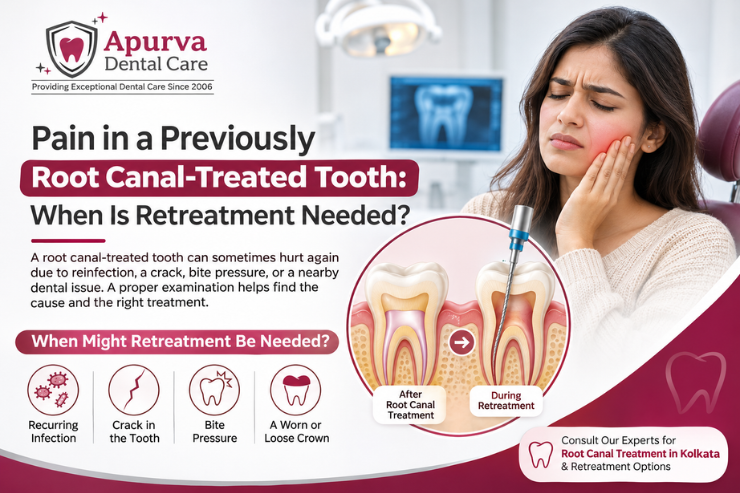
A tooth treated years ago starts aching again, and the first thought is often, “Was all that effort wasted?” Not necessarily. The pain is real, and it deserves a proper look rather than guesswork. Pain in a root canal-treated tooth can come from reinfection, a crack, bite pressure, or a nearby tooth. Finding the cause comes first. Retreatment, minor surgery, or extraction are options depending on the case, and individual results vary.
Can a tooth hurt months or years after root canal treatment?
Yes, it can. A root canal removes the infected tissue inside the tooth, but the gum and bone around it still respond to bite pressure and bacteria. Discomfort may appear months or even years later.
- A dull ache while chewing
- Tenderness when the tooth is tapped
- A small pimple-like bump on the gum
- Pain that comes and goes
Recurring pain alone does not prove treatment failure. Many causes have nothing to do with how the first treatment was done.
A Quick Fact: According to research, non-surgical root canal retreatment shows a success rate of about 71% to 87% at one to three years, depending on how success is measured. These are averages across many patients, and individual results vary.
Possible causes of symptoms in an already treated tooth
Pain can have more than one source, which is why the cause matters before any decision is made.
Persistent infection, missed anatomy, or reinfection through leakage
- Some canals are narrow, curved, or extra, and can be hard to clean fully for the first time.
- A worn filling or loose crown can let bacteria seep back in
- Infection from the original problem may not have settled completely
Cracks, bite pressure and problems in neighbouring teeth
- A fine crack in the root or crown
- A crown or filling sitting slightly high
- Gum disease or decay in a nearby tooth, with pain felt in the treated one
- Jaw clenching or grinding, which loads the tooth repeatedly
How the dentist investigates the problem
Symptom history, examination and appropriate imaging
The conversation comes first: when the pain began, what triggers it, and whether it settles on its own.
- Gentle tapping and bite tests
- A check of the gum and bone around the tooth
- Imaging suited to the case, sometimes a 3D scan when the canals are complex
Checking the existing crown and whether the tooth is restorable
- How well the crown fits, and any gap at its edge
- Decay hidden beneath it
- Whether enough healthy tooth remains
- Whether a crack runs below the gum line
A poorly fitting crown, or decay beneath it, can let bacteria reach the canals again, so this check can explain symptoms even when the canals themselves are sound.
This step shapes every option that follows.
What nonsurgical root canal retreatment involves
Root canal treatment in Kolkata often includes retreatment when a treated tooth develops fresh symptoms. Some patients search for root canal treatment correction, but retreatment is better understood as a second, careful clean-out rather than the fixing of a mistake, since many causes develop over time.
Reopening the tooth and removing the previous filling material
- Local anaesthetic is used for comfort
- The crown or filling is opened to reach the canals
- The old filling material is carefully removed
Cleaning, resealing, and planning the final restoration
- The canals are cleaned, shaped, and disinfected again
- They are sealed, sometimes over more than one visit
- A new crown or filling is planned to protect the tooth afterwards
The advantage is that the natural tooth may stay in place, though this depends on the case.
When surgery or extraction may be considered instead
| Option | When It May Be Considered | Worth Knowing |
| Retreatment | Canals can be reached, and the tooth is restorable | Keeps the natural tooth; may need more than one visit |
| Root-end surgery | Infection persists after retreatment, or the crown needs to stay | A minor procedure; healing time varies |
| Extraction | The tooth is deeply cracked or cannot be restored | Replacement options such as an implant or bridge can be discussed |
Root-end surgery means the dentist reaches the tip of the root through the gum, cleans the infected area, and seals the root end, while the crown stays in place. Extraction is removal of the tooth, with replacement options discussed afterwards.
No option suits everyone. The choice stays with you, once the findings are explained.
What affects the outlook, appointments and recovery?
- Number and shape of the canals
- Size of any infection
- Quality of the existing crown or filling
- Cracks, gum health, and bite habits
A tooth with several narrow canals takes longer to clean than one with a single wide canal, and a deep crack can limit which options are open.
The cleaning stage usually takes one to two visits, with an extra visit for the crown. Mild soreness for a few days is common. In complex cases, a dentist may suggest an endodontic specialist, which is a normal part of careful treatment. Outcomes and timelines vary from person to person.
Symptoms that require prompt dental attention
Swelling, fever, or worsening pain; urgent help for breathing or swallowing difficulty
- Swelling of the gum, cheek, or face
- Fever along with tooth pain
- Pain that is getting worse instead of settling
- A bad taste or discharge near the tooth
Swelling that makes breathing or swallowing difficult needs emergency medical care straight away. For other symptoms, an early check with a dentist who handles root canal treatment in Kolkata helps find the cause sooner.
Get Clarity on Your Treated Tooth That Hurts
A previously treated tooth that hurts is not a verdict on the earlier work, or on the tooth’s future. Pain can come from several sources, and the right path depends on what an examination finds. Retreatment, surgery, and extraction each have advantages and limits, and the choice remains yours. If a treated tooth has been bothering you, a conversation with a qualified dentist offering root canal treatment in Kolkata is a good first step toward understanding where it stands.
Author:
Dr. Ruchi Lohia
BDS, TMJ Specialist, & Head Dentist at Apurva Dental Care
Frequently Asked Questions
Q1. Does pain mean the first root canal was done incorrectly?
Not necessarily. Pain can come from a crack, a loose crown, gum problems, or bite pressure that developed later. A dental examination helps identify the actual cause.
Q2. Will my crown have to be removed or replaced?
Sometimes. The dentist may reach the canals through the crown, or remove it if it is loose, decayed beneath, or poorly fitting. This depends on the individual tooth.
Q3. Can every root canal-treated tooth be retreated?
No. Deep cracks, too little healthy tooth, or severe gum and bone loss can limit retreatment. In those cases, surgery or extraction may be discussed, depending on the examination findings.
Q4. How long does root canal retreatment take?
Many cases need one to two visits for cleaning and sealing, each often lasting an hour or more. A final crown adds another visit. Timelines vary with the tooth’s complexity.
Q5. Is retreatment more uncomfortable than the first root canal?
Local anaesthetic keeps the procedure comfortable. Mild soreness for a few days afterwards is common, though experiences differ. Persistent or worsening pain should be reported to the dentist.
Disclaimer: This content is for general educational purposes only and does not constitute medical advice. Outcomes vary between individuals. Please consult your treating doctor for a personalised assessment before starting any treatment.