
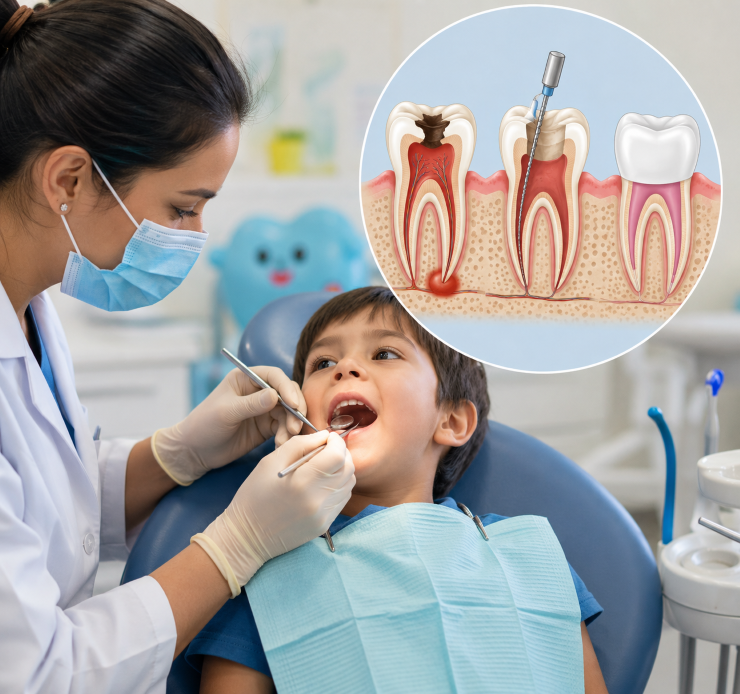
If your dentist has just told you that your child needs a “root canal” in a milk tooth, your first reaction is probably panic. Root canals sound painful, complicated, and — for many parents — like something reserved for adults with badly damaged teeth. So why would a tooth that’s going to fall out anyway need this kind of treatment?
It’s a fair question, and one that deserves a clear, honest answer. This guide breaks down exactly what a pediatric root canal (technically called pulp therapy) involves, when it’s genuinely necessary, and what happens if it’s skipped.
Why Baby Teeth Matter More Than Most Parents Realise
Many parents assume milk teeth are “temporary” and therefore not worth saving aggressively. In reality, baby teeth play a far bigger role than most people expect.
They hold space for permanent teeth
Each baby tooth acts as a placeholder. If it’s lost too early, nearby teeth can drift into the gap, leaving no room for the adult tooth to erupt correctly later.
They support speech and chewing development
Front and back milk teeth help children pronounce sounds clearly and chew food properly during crucial growth years.
They protect the developing permanent tooth underneath
Every baby tooth sits directly above a developing adult tooth. An untreated infection in the milk tooth can spread downward and damage the permanent tooth forming beneath it — before it has even emerged.
This is precisely why dentists don’t take extraction lightly, even for a tooth that would naturally fall out in a year or two.
What Actually Happens Inside a Damaged Baby Tooth
To understand why a root canal is sometimes unavoidable, it helps to know what’s happening beneath the surface.
A tooth has three layers:
- Enamel — the hard, protective outer shell
- Dentin — the softer layer beneath enamel
- Pulp — the innermost tissue containing nerves and blood vessels
When deep decay, a fracture, or trauma reaches the pulp, bacteria can infect this soft tissue. Once infected, the pulp cannot heal on its own — the body has no way to fight off the infection inside a sealed tooth chamber. Left untreated, the infection often spreads to the bone below and can become genuinely painful for the child.
Signs That May Indicate the Need for Pulp Therapy
Parents are often the first to notice something isn’t right. Common signs include:
- Persistent tooth pain, especially at night
- Sensitivity to hot or cold that lingers
- Visible swelling on the gum near a tooth
- A small pimple-like bump (abscess) on the gums
- Dark discoloration of a single tooth
- A deep cavity visible on the tooth surface
- Pain while chewing on one particular side
Not every case is dramatic — sometimes decay is deep but the child reports very little pain, which is why regular dental check-ups matter even before symptoms appear.
Root Canal vs Extraction: How Dentists Decide
This is usually the biggest question on a parent’s mind. Not every damaged baby tooth needs a root canal, and not every damaged tooth needs to be extracted either. The decision generally depends on a few factors.
When pulp therapy (root canal) is usually recommended
- The tooth still has enough structure to be restored afterward
- There’s sufficient time left before the tooth would naturally fall out
- The infection hasn’t damaged the underlying bone extensively
- The child is cooperative enough for the procedure
When extraction may be considered instead
- The tooth is severely broken down with little structure remaining
- The infection has significantly damaged the surrounding bone
- The tooth is very close to naturally falling out anyway
- A space maintainer can adequately hold the gap until the permanent tooth arrives
A dentist typically examines the tooth clinically and takes an X-ray to assess how much of the root and surrounding bone is affected before recommending either option.
What Does a Pediatric Root Canal Actually Involve?
The procedure is different — and generally simpler — than what most parents picture when they hear “root canal.”
Step-by-step overview
- Numbing the area so the child feels minimal to no discomfort
- Removing the infected pulp tissue from inside the tooth
- Cleaning the inner chamber to eliminate bacteria
- Filling the space with a special material designed to resorb naturally as the baby tooth eventually falls out
- Placing a crown (usually stainless steel or tooth-colored) to protect and strengthen the treated tooth
Because baby tooth roots are structured differently from adult roots, the filling material used is specifically designed to dissolve along with the root when it’s time for the tooth to fall out naturally.
Is the Procedure Painful for a Child?
This is the concern almost every parent has, understandably. In practice:
- Local anesthesia numbs the area effectively before treatment begins
- Most children report little to no pain during the procedure itself
- Mild discomfort for a day or two afterward is normal and manageable
- Pediatric dentists are trained specifically in techniques that reduce anxiety and discomfort in young patients
Compare this to the pain of an untreated infection, which tends to be far more disruptive — often involving swelling, sleepless nights, and difficulty eating.
What Happens If You Skip Treatment Altogether?
It can be tempting to wait and see, especially if the child isn’t in visible pain. However, an infected pulp does not resolve on its own. Over time, untreated infection can lead to:
- Spread of infection to the jawbone
- Damage to the developing permanent tooth beneath
- Facial swelling or abscess formation
- Early tooth loss, which may cause spacing problems for adult teeth
- Increased pain and more complex treatment later
Early intervention is almost always simpler, gentler, and more predictable than treating an advanced infection later.
Caring for the Tooth After Treatment
Once pulp therapy is complete, a few simple habits help the tooth stay healthy until it naturally falls out:
- Maintain regular brushing and flossing around the treated tooth
- Avoid very hard or sticky foods on that side initially
- Attend follow-up visits so the dentist can monitor healing
- Continue routine dental check-ups every six months
How to Decide What’s Right for Your Child
Every child’s case is different, and the right decision depends on the tooth’s condition, the child’s age, and how much time is left before that tooth would naturally fall out. The most reliable way to know what your child specifically needs is a clinical examination and an X-ray by a qualified dentist — this is not something that can be accurately assessed from symptoms alone.
In Summary
A root canal in a baby tooth isn’t about “overtreating” a tooth that’s going to fall out anyway — it’s about protecting your child from pain, infection, and complications that could affect their permanent teeth later. Understanding the signs, knowing when treatment is genuinely necessary, and acting early makes the entire process far simpler for both parent and child.
If you’re looking for reliable, well-explained dental treatment in Kolkata Kankurgachi and want a professional opinion on your child’s specific case, Apurva Dental Care is available for a consultation to help you make an informed decision for your child’s smile.
Author
Dr. Trisha Das Sharma
BDS, MDS – Pediatric & Preventive Dentistry | Pediatric Dentist
Frequently Asked Questions
1. Can a baby tooth get infected even if it looks fine from outside?
Yes. Decay often starts between teeth or beneath the surface, where it isn’t visible. By the time discoloration or a hole appears, the infection may have already reached the inner pulp.
2. Will the root canal material dissolve on its own?
Yes, in baby teeth, dentists use a special filling material that is designed to break down naturally, at the same pace as the tooth’s root, so it doesn’t interfere with the tooth falling out normally.
3. Does my child need to be put to sleep for this treatment?
Not usually. Most pediatric root canals are done with local numbing only. Sedation is considered only in specific cases, such as very young or highly anxious children, and is discussed individually with parents.
4. What if my child refuses to sit still during the procedure?
Pediatric dentists are trained in behavior management techniques specifically for young patients, using calm communication, distraction, and a comfortable environment to help children stay relaxed.
5. Will this tooth need a cap or crown afterward?
In most cases, yes. Since the tooth structure is weakened after treatment, a crown is placed on top to protect it from breaking and to help it function normally until it falls out.
This content is for general educational purposes only and does not constitute medical advice. Individual results may vary. Please consult your treating doctor for a personalised assessment before starting any treatment.