
Straightening crooked teeth takes both time and routine, so the first question most people ask before starting clear aligners is how long it will really take. The answer depends on the person, but most adults complete Invisalign in 6 to 18 months. Simple cases may finish sooner, and complex ones can take longer.
This guide explains what shapes the timeline, how each stage works and how to stay on schedule.
Typical Invisalign Treatment Timelines
Treatment time mainly depends on how much your teeth need to move. These are general estimates, and your dentist can give an accurate figure only after a scan and examination.
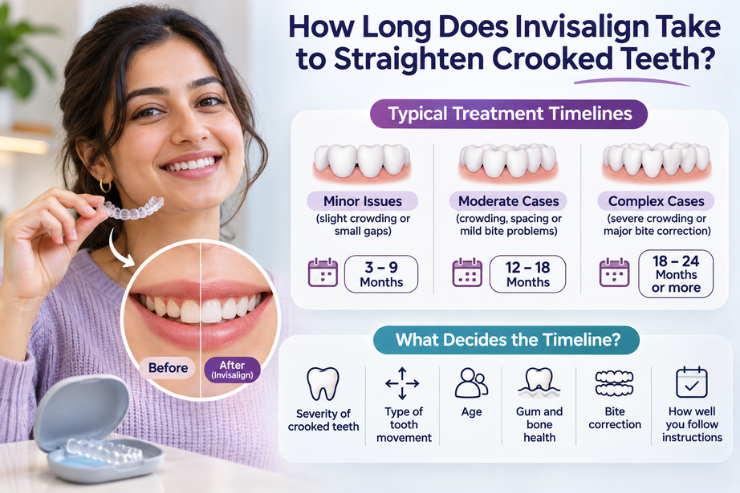
- Minor issues (slight crowding or small gaps): 3 to 9 months
- Moderate cases (crowding, spacing or mild bite problems): 12 to 18 months
- Complex cases (severe crowding or major bite correction): 18 to 24 months or more
Be cautious about promises of results in a few weeks. Moving teeth too fast can damage gums, roots and bone.
What Decides How Long Invisalign Takes
Severity of Crooked Teeth
Slightly uneven teeth need small movements. Heavily overlapped teeth need space created first, which adds months.
Type of Tooth Movement
Tilting a tooth is easier than rotating it or moving it up or down. Rotated canines and premolars often take the longest.
Age
Teenagers often respond faster because their bone is still developing. Adults can be treated just as successfully, usually a little more slowly.
Gum and Bone Health
Healthy gums are essential for safe tooth movement. Gum disease or cavities must be treated first, which can delay the start.
Bite Correction
An overbite, underbite or crossbite may need small rubber bands (elastics) along with aligners, which can extend treatment.
How Well You Follow Instructions
This is the biggest factor in your control. Aligners work only when they are in your mouth.
How Invisalign Treatment Works, Step by Step
1. Examination and Scan
Your dentist checks your teeth, gums and bite, and takes X-rays and a 3D digital scan.
2. Digital Treatment Plan
Software maps out how your teeth will move and shows the expected duration and final result.
3. Series of Custom Aligners
Each aligner is worn for 1 to 2 weeks and moves teeth by a fraction of a millimetre. Small tooth-coloured bumps called attachments may be bonded to help the aligners grip.
4. Regular Check-Ups
Visits every 6 to 8 weeks confirm that teeth are moving as planned and that the aligners fit well.
5. Refinement, If Needed
Some teeth lag behind the plan. A few extra aligners can fine-tune the result and may add a few months.
6. Retainers
Teeth tend to drift back after treatment. Retainers are worn full time at first and later only at night to keep the result stable. They are part of the process and should not be skipped.
Daily Habits That Keep You on Schedule
- Wear aligners 20 to 22 hours a day
- Remove them only to eat, drink anything other than plain water, and clean your teeth
- Brush and floss before putting them back, so food is not trapped against the teeth
- Change to the next aligner only on the date your dentist advises
- Keep them in their case, never wrapped in a tissue or napkin
- Use “chewies” (soft plastic rolls) to seat the aligners fully
- Keep your previous set safe as a backup
What Can Delay Invisalign Treatment
- Wearing aligners for fewer hours than advised
- Lost or broken aligners
- Missed check-ups
- New cavities or gum problems during treatment
- Attachments that fall off and are not fixed
- Moving to the next aligner too early
Invisalign vs Braces: Which Is Faster?
For mild to moderate cases, the treatment time is usually similar. Metal braces generally take 18 to 36 months.
For severe crowding, jaw-related bite problems or movements aligners cannot achieve, braces may be faster or more suitable. Aligners also suit only people who can wear them consistently every day. Your dentist can tell you which option fits your teeth.
Choosing Where to Get Treated
If you are comparing options at a dental clinic in north Kolkata, or in any other city, it helps to ask for:
- A detailed examination with X-rays and a 3D scan
- A clear estimate of treatment duration
- An explanation of the retainer plan after treatment
- Honest advice on whether aligners suit your case
Conclusion
Invisalign is a predictable way to straighten teeth, but the timeline is personal. It depends on your teeth, your gum health and your daily discipline. Most people notice steady change within a few months and complete treatment in under two years.
If crooked teeth have been on your mind, a detailed assessment at a trusted dental clinic in north Kolkata is the simplest first step toward knowing your exact timeline. A straighter smile begins with one consultation.
Author:
Dr. Ruchi Lohia
BDS, TMJ Specialist, & Head Dentist at Apurva Dental Care
Frequently Asked Questions
1. Can Invisalign straighten teeth in 6 months?
Yes, but only for minor problems such as slight crowding or small gaps. Most cases need longer, so a dentist’s assessment is the only way to know your timeline.
2. Is Invisalign faster than braces?
For mild to moderate cases, the time is about the same. For complex cases, braces can sometimes be quicker.
3. How many hours a day should I wear my aligners?
Around 20 to 22 hours a day. Wearing them less slows progress and can add months to treatment.
4. Does Invisalign hurt?
You may feel mild pressure or soreness for a day or two when you start a new aligner. It usually settles on its own and is much milder than a toothache.
5. Do I need a retainer after Invisalign?
Yes. Without a retainer, teeth slowly move back toward their old position. Wearing it as advised keeps your new smile in place.
Disclaimer: This blog is for general educational purposes only and is not a substitute for professional dental advice, diagnosis or treatment. Every patient’s oral health needs are different, so please consult a qualified dentist for guidance specific to your condition.