
You have finished your braces or clear-aligner treatment. Your teeth look straighter, and daily life feels easier. Then, months later, you notice a small gap or a crowded front tooth.
Does this mean your treatment has failed? Not necessarily.
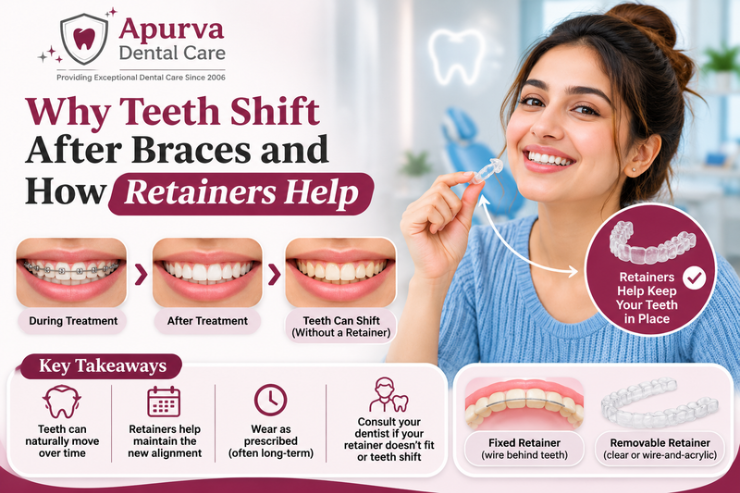
Teeth shifting after braces is possible because teeth are not fixed permanently in one position. Retainers help maintain alignment after active treatment ends.
Why Do Teeth Move After Orthodontic Treatment?
Braces and aligners gradually move teeth through the jawbone. The surrounding bone and tissues adapt during treatment. But that adjustment continues after the appliances are removed.
Several factors can influence how teeth settle.
1. The surrounding tissues need time to settle
Fibres around the teeth can pull them towards their previous positions. Bone also continues adapting to the new alignment.
This is one reason retainer wear matters soon after treatment.
2. Teeth naturally change position with age
Even people who never wore braces may notice crowding over time.
Changes in the bite, tooth wear, and ageing can influence alignment. Orthodontic treatment does not stop these natural changes.
3. Gum health and other factors matter
Gum disease can weaken the tissues supporting teeth. Missing teeth, certain oral habits, or changes in the bite may also contribute.
Unexpected or rapid movement should be assessed rather than assumed to be normal relapse.
What Happens If You Stop Wearing Your Retainer?
Without a retainer, teeth may gradually move away from their corrected positions. This is called orthodontic relapse.
The first sign may be slight tightness when you try wearing your retainer again.
Later, you might notice:
- Front teeth beginning to overlap.
- A previously closed gap reopening.
- Slight changes in your bite.
- A removable retainer no longer fitting comfortably.
Movement does not happen at the same speed for everyone.
People may also notice teeth moving after Invisalign or other clear-aligner treatments. Both braces and aligners generally require a retention plan.
How Long Do You Need Retainers After Braces?
There is no single schedule suitable for everyone.
Your orthodontist may recommend more frequent wear immediately after treatment. This is often followed by night-time wear.
For many patients, some form of long-term, sometimes lifelong, retention is recommended.
That does not necessarily mean wearing a removable retainer throughout the day.
The schedule depends on your teeth, bite, retainer type, and treatment history.
Do not reduce retainer wear simply because your teeth appear straight. Follow the instructions provided by your treating orthodontist.
Fixed vs Removable Retainers: What Is the Difference?
Both types help maintain tooth alignment. However, they differ in design, cleaning, and daily use.
Removable retainers
These may be clear plastic trays or wire-and-acrylic appliances.
You can remove them for meals and cleaning.
- Advantages: Easy to remove for brushing and flossing.
- Considerations: They must be worn as directed. They can also be lost, cracked, or damaged by heat.
Fixed retainers
A thin wire is bonded behind selected teeth, commonly the front teeth.
It remains in place until professionally removed or repaired.
- Advantages: No need to remember daily insertion.
- Considerations: Cleaning around the wire requires attention. Bonding may loosen and needs periodic checks.
A fixed retainer does not necessarily control every tooth.
Some patients need both fixed and removable retainers. The choice depends on their orthodontic requirements.
My Retainer Feels Tight or Does Not Fit. What Should I Do?
A slightly snug retainer may indicate minor tooth movement.
However, significant pain, difficulty inserting it, or visible gaps between the tray and teeth require assessment.
Do not force a retainer into place.
Doing so may hurt your teeth or gums, or damage the appliance.
Instead:
- Keep the retainer safe and bring it to your appointment.
- Note how long you have gone without wearing it.
- Contact your orthodontist to check its fit and your tooth positions.
If a fixed retainer breaks or becomes loose, arrange a review.
Teeth can move even when only one section of the wire has detached.
Can Shifted Teeth Move Back Without More Treatment?
This depends on how much movement has occurred.
Sometimes, a minor change can be managed through a professionally assessed retention plan.
However, an old retainer is not a substitute for orthodontic treatment.
If teeth have shifted considerably, a replacement retainer may only maintain their current position.
Correcting the movement might require a short course of aligners or braces.
In other situations, no additional active treatment may be necessary.
An examination helps determine whether correction is required.
How Can You Prevent Teeth from Shifting Again?
Maintaining alignment involves more than simply keeping your retainer.
A few practical habits can help:
- Wear retainers as prescribed: Set a reminder if night-time wear is part of your routine.
- Clean retainers correctly: Follow your orthodontist’s instructions. Avoid hot water for heat-sensitive trays.
- Store them safely: Use a protective case instead of wrapping removable retainers in tissue.
- Maintain gum health: Brush, clean between your teeth, and attend recommended dental examinations.
- Check the fit: Seek advice if a retainer cracks, loosens, or stops fitting.
Parents can help teenagers establish a consistent routine after orthodontic treatment.
When Should You Speak to a Dentist?
Consider an assessment if your teeth begin overlapping again, a gap reopens, or your bite feels different.
A broken fixed retainer or painful removable retainer also deserves attention.
At Apurva Dental Care, a dental clinic in North Kolkata, an examination can help identify changes in alignment.
The dentist can assess whether an orthodontic review or further treatment is appropriate.
Preventing Teeth from Shifting After Braces or Aligners
Finishing braces or aligners is an important milestone. However, maintaining alignment is an ongoing process.
Retainers after braces help reduce unwanted tooth movement, even when your teeth feel stable.
If your retainer no longer fits or your teeth look different, consider an orthodontic assessment.
Small changes do not automatically mean you need to repeat treatment. Understanding the cause helps determine the next step.
Frequently Asked Questions
Will my teeth shift if I miss wearing my retainer for one night?
Not necessarily. Missing one night does not mean your teeth will visibly move.
Resume your prescribed schedule. Seek advice if the retainer no longer fits.
Can I use my old retainer to straighten my teeth again?
Do not force a poorly fitting retainer onto your teeth.
An orthodontic assessment can determine whether the retainer is suitable or another approach is needed.
Do adults need retainers after clear aligners?
Yes. Adults also need a retention plan because teeth can change position after treatment.
Can teeth shift even with a fixed retainer?
Yes. A fixed retainer may become loose or break. It may also retain only selected teeth.
Regular checks help identify these problems.
Medical Disclaimer: This article is intended for general dental education. It does not replace an individual orthodontic examination, diagnosis, or treatment plan.