
Inlays & Onlays
A precisely fitted, lab-crafted restoration that repairs a damaged tooth more conservatively than a crown while offering more strength than a standard filling.
What Is Inlays & Onlays?
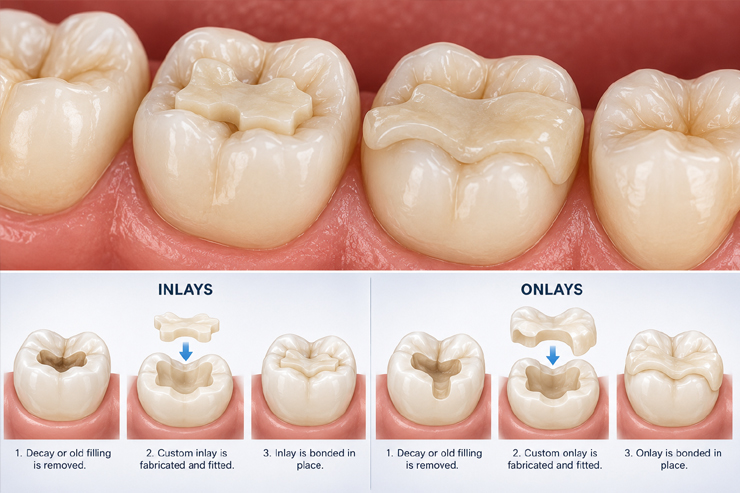
Inlays and onlays are custom-made restorations, fitted between or over the cusps of a tooth, used when a cavity or fracture is too large for a filling but doesn’t require the full coverage of a crown.
Made from durable materials like ceramic or composite, they are bonded precisely into place, preserving more of your natural tooth than a crown would while restoring full chewing strength.
- More conservative than a full crown
- Stronger and more durable than a standard filling
- Precisely fitted in the dental laboratory
- Shade-matched for a natural appearance
- Preserves more of your healthy tooth structure

Signs You May Need Inlays & Onlays
- A cavity too large for a standard filling
- A cracked tooth cusp that doesn’t need a full crown
- An old, worn filling that needs a stronger replacement
- Your dentist recommends a lab-made restoration for durability
Not sure if this applies to you? A short consultation will confirm — there’s no obligation to proceed.
What Happens, Step by Step
Assessment
The dentist examines the damaged tooth and confirms whether an inlay or onlay is appropriate.
Tooth Preparation
Damaged tissue is removed and the tooth is shaped to receive the restoration.
Impressions
Precise impressions are taken and sent to the lab for fabrication, with a temporary placed meanwhile.
Custom Fabrication
Your inlay or onlay is crafted to match your bite and tooth shade.
Bonding
The finished restoration is checked for fit, then bonded securely into place.
Common Questions About Inlays & Onlays
An inlay fits within the grooves of a tooth, while an onlay also covers one or more cusps for larger areas of damage.
Fillings are placed directly in one visit, while inlays and onlays are custom-made in a lab for a stronger, more precise fit.
With good care, they typically last 10–15 years, similar to crowns.
No, it's performed under local anaesthesia and is generally as comfortable as getting a filling or crown.
Yes, if a filling is large or repeatedly breaking, an inlay may give stronger support. The dentist checks tooth strength, bite pressure, and cavity depth first. This reduces rushed treatment decisions.
Sometimes yes. An inlay can repair the damaged area while keeping a more natural tooth than a crown, but only if the remaining tooth is strong enough. This supports safer treatment planning.
It may help if food trapping is caused by a broken tooth wall or weak contact. Gum health and nearby tooth position must also be checked. This keeps expectations more realistic.
Tooth-coloured inlays usually blend well with natural teeth, especially for back teeth that show while laughing. Shade matching helps avoid the look of old dark fillings. This helps protect long-term results.
Yes, after the final inlay is fixed and the bite feels comfortable, normal chewing usually returns. Avoid very hard biting at first if your dentist advises. It also makes follow-up easier.
Your smile deserves expert care. Book your appointment today
Same-week appointments available at our Kankurgachi clinic. Speak to our care team by phone, WhatsApp, or the form below.